Case Report | Vol 11 | Issue 3 | September-December 2025 | Page: 13-16 | Kompal Jain, Gaurav Gupta, Arun Puri
DOI: https://doi.org/10.13107/jaccr.2025.v11.i03.290
Open Access License: CC BY-NC 4.0
Copyright Statement: Copyright © 2025; The Author(s).
Submitted: 19/01/2025; Reviewed: 13/02/2025; Accepted: 29/11/2025; Published: 10/12/2025
Author: Kompal Jain [1], Gaurav Gupta [2], Arun Puri [3]
[1] Department of Anaesthesiology, Wattford General Hospital, West Hertfordshire Teaching Hospitals NHS Trust, United Kingdom.
[2] Department of Anaesthesia and Critical Care, North Tees and Hartlepool NHS Foundation Trust, United Kingdom.
[3] Department of Anaesthesiology, Max Superspecialty Hospital, I.P Extension Patparganj, New Delhi, India.
Address of Correspondence
Dr. Gaurav Gupta,
Specialist Doctor, Department of Anaesthesia and Critical Care, North Tees and Hartlepool NHS Foundation Trust, United Kingdom.
Email: gauravanaes@gmail.com
Abstract
Introduction: Transurethral resection of prostate (TURP) is one of the most common surgeries in men in India. One of the most alarming symptoms of TURP syndrome is visual disturbances, although the incidence is rare. We report a patient with transient bilateral blindness after TURP and speculate the need for preoperative ophthalmic examination and serial serum sodium levels in perioperative period.
Case Report: 71 years old male, a known case of hypertension, cataract and benign prostate hypertrophy (BPH) underwent TURP under subarachnoid block. Postoperatively, patient had an episode of transient blindness associated with hyponatremia. Patient regained his vision after few hours to finger counting at 3 meters (his preoperative visual acuity) with serum sodium level of 139 mmol/L.
Conclusion: Visual disturbances can be an early sign of TURP syndrome and immediate intervention is needed. Preoperative ophthalmic evaluation should be done in patient with preexisting comorbidity like hypertension, diabetes mellitus and visual pathologies like cataract or glaucoma, so as to document and later, determine complete reversal or residual visual disturbances.
Keywords: TURP, Preoperative ophthalmic examination, Transient blindness, Hyponatremia.
Introduction
Transurethral resection of prostate (TURP) is one of the most common surgeries in men in India. Despite improved surgical techniques and anesthesia, 2.5-20% of patients undergoing TURP show one or more manifestations of TURP syndrome and 0.5-5% die perioperatively [1]. TURP syndrome is an iatrogenic condition with constellation of signs and symptoms occurring due to systemic absorption of irrigating fluid through open venous sinuses in prostate leading to acute changes in intravascular volume, plasma sodium concentration and osmolarity. These signs and symptoms are related to cerebrovascular, cardiac, pulmonary and metabolic changes. The metabolic shifts include hypoosmolarity, hyponatremia and solute toxicity related to different irrigating fluids. One of the most alarming symptoms is visual disturbances although incidence is rare.
Different authors have reported different pathogenesis for visual disturbances [2-10]. We report a patient with transient bilateral blindness after TURP and we speculate the need of preoperative ophthalmic examination and serial serum sodium levels in perioperative period.
Case Report
A 71-year-old male, weighing 50 kg , having benign prostate hypertrophy was posted for TURP. Patient was hypertensive since fifteen years, taking combination of amlodipine 5 mg and atenolol 50 mg. He had cataract since one year and was advised surgery. Patient did not have any other relevant past history. General and systemic examinations were normal. Preoperative investigations included Haemoglobin – 15 g/dl, TLC- 11.8* 103/ μl, Platelet count – 1.5 lakh/μL, blood urea-21.8 mg/dl, serum creatinine – 0.8 mg/dl, serum sodium- 134 mmol/l, serum potassium- 4.3 mmol/l, serum chloride -100 mmol/l. ECC and CXR showed normal sinus rhythm and tiny calcification lesion, respectively. Ultrasound depicted that prostate weighed 81 grams Patient’s preoperative vitals were pulse rate – 80/min, blood pressure – 130/80 mm Hg and saturation – 99% on room air. After reviewing and confirming the fasting status, the patient was shifted to operation theatre. Standard monitoring including blood pressure cuff, pulse oximeter and electro-cardiogram were applied. Intravenous line was secured. Under all aseptic conditions, using midline approach, subarachnoid block was administered using 27G Quincke needle and 15 mg bupivacaine (heavy). Surgery was started after attaining anaesthesia to desired dermatome of T10 level. TURP lasted for 90 minutes, using 52 liters of 1.5% glycine. Assuming average rate of fluid absorption to be 20 ml/ min, the approximate value of fluid absorbed was 1.8 L. The amount of intravenous fluid administered was 700 ml Ringer Lactate. Intraoperatively, the patient was apparently comfortable and did not have any complaint. At the end of surgery, just before shifting from operation theatre, the patient became anxious and restless. He complained of blurring of vision, finally progressing to complete blindness. ECG was normal, ABG was sent and Injection Furosemide 40 mg, intravenous was given.
Irrigation fluid via catheter was changed from glycine to Normal Saline. Patient was reassured and he did not have any other associated sign or symptom. Serum Sodium level was 117 mmol/l. Patient was shifted to Intensive Care Unit. Ophthalmology consultation revealed that pupils had sluggish reaction to light, Perception of light was absent and fundus examination showed nasal margin blurring. On examination, finger counting was present at 1 meter. After 3-4 hrs, serum sodium was 122 mmol/l. Injection Magnesium Sulphate 2 gram and injection 10% Calcium Gluconate 10 ml were administered slowly as serum magnesium and serum calcium levels were 1.46 mg/dl and 7.6 mg/dl, respectively. After 7-8 hours, serum sodium was corrected to 129 mmol/L and patient was able to read the newspaper. Later, patient had serum sodium level of 139 mmol/L and finger counting at 3 meters. Patient’s vision recovered and was shifted to the room. We could not confirm that whether there was complete recovery of ocular symptoms as we did not have preoperative ophthalmic examination as baseline. We relied on patient’s version that his eye sight was as good as was in preoperative period. Patient was followed for three days and he had no fresh complaint.
Discussion
An irrigating fluid is used in Transurethral resection of prostate to dilate the mucosal spaces, enable better operating field, removal of cut tissue, debris and blood. Various irrigating fluids used are sterile water, glycine, mannitol, glucose, cytal and urea with their merits and demerits [1]. One of the common irritating fluids used in TURP is 1.5% glycine. Glycine is an endogenous amino acid. The solution is inert, transparent, without an allergic reaction potential, inexpensive and slightly hypotonic (230 mosm/L). But the solution is unphysiological, as it lacks electrolyte. Its excessive absorption is a recognized complication.[8]Excess of glycine absorbed in circulation is toxic to heart and retina and may lead to hyper – ammonemia. Various theories [2-10] have been proposed for the etiology of visual disturbances related to metabolic disturbances in TURP syndrome [Table1] .
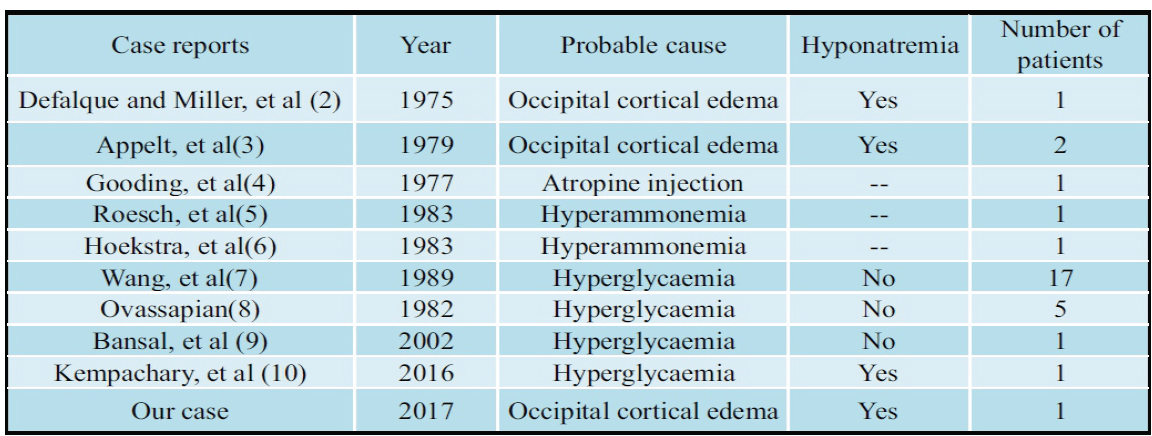
These include water intoxication and hyponatremia leading to occipital cortical oedema [2, 3], perioperative atropine injection during the operation [4], hyperammonemia [5, 6] and hyperglycinemia [7-10]. Atropine injection [4] and hyperammonemia [5, 6] were excluded as probable cause of transient blindness as atropine was not administered during the perioperative period. Ammonia levels were not measured, as patient had no other neurological symptoms. Hyperammonemia causes central nervous system depression by hyperammonemic encephalopathy and is associated with neurological symptoms. Wang et al [7] found no significant correlation between hyper-ammonemia and TURP syndrome. Hyperglycinemia has also been suggested the probable cause of visual disturbances [7-10]. Glycine levels were not done due to non availability of test at our centre. Glycine is also known to be a major inhibitory neurotransmitter in the spinal cord and brain stem with similar actions like gamma amino butyric acid on the chloride ion channel, which may cause severe depressant effect on CNS and visual disturbances. Glycolic acid, formate and formaldehyde are other metabolites of glycine which are notorious to cause visual disturbances with intact perception of light. However, blink reflexes and pupillary responses to light and accommodation are lost. The fundus appears normal. Other symptoms associated with glycine toxicity are nausea, vomiting, slow respiration, seizures, spells of apnea and cyanosis, hypotension, oliguria, anuria and death. Glycine toxicity is very uncommon in TURP patients probably because most of the absorbed glycine is retained in the periprostatic and retroperitoneal spaces, where it has no systemic effect. Masey et al [11] also hypothesized that glycine toxicity is independent of reduced sodium levels and elevated levels of glycine may contribute directly to visual disturbances. Visual disturbances attributed to cerebral cortical oedema and low sodium levels were reported by Defalque and Miller [2] in one patient and Appelt, et al [3] in two patients. Water intoxication causes hypoosmolality and hyponatremia leading to intracellular shifting of fluid and cerebral oedema. This cerebral edema can disturb the visual pathway causing visual disturbances. In our patient, visual sensations like perception of light, blink reflex were absent. Fundus examination of both eyes showed slight flaring of nasal margin. Pupils were reacting sluggish to light. Patient responded to diuretic and improvement in vision was related to increasing trend in serum sodium. The clinical signs and symptoms were more in favour of water intoxication disturbing the visual pathway with hyponatremia and would be the probable cause of transient blindness in the patient. With unknown levels of glycine, hyperglycinemia could not be excluded.
Conclusion
To conclude, visual disturbances can be an early sign of TURP syndrome and immediate intervention should be done. Preoperative ophthalmic evaluation should be done in patient with preexisting comorbidity like hypertension, diabetes mellitus and visual pathologies like cataract or glaucoma, so as to determine complete reversal or residual visual complaints. Anaesthesiologist should observe the surgical field for bleeding, haemostasis, duration of the procedure and amount of irrigating fluid used. Frequent interactions with the patient during surgery is necessary to detect early neurological symptoms. Procedures lasting for more than sixty minutes and weight of prostate more than 60 grams are mostly related with complications. Therefore, surgeon should be informed about the exceeding time of resection or amount of fluid being used and hence, plan two staged procedure for these cases. Use of newer techniques such as vaporization of tissue by laser like Ho:Yag, Nd:Yag, diode instead of resection may reduce the absorption of fluid and its consequences.
References
1. Moorthy H K, Philip S. TURP syndrome- current concepts in the pathophysiology and management. Indian J Urol 2001; 17:97-102
2. Defalque RJ, Miller DW: Visual disturbances during transurethral resection of the prostate. Can Anaesth Soc J 1975; 22: 620-621
3. Appelt GL, Benson GS, Corriere Jr JN: Transient blindness: Unusual initial symptom of transuretheral prostatic resection reaction. Urology 1979; 13:402-404
4. Gooding JM, Holcomb MC: Transient blindness following intravenous administration of atropine. AnesthAnalg (Cleve) 1977; 56:872-873
5. Roesch RP, Stoelting RK, Lingerman JE, Kahnoski RJ, Backes DJ, Gephardt SA: Ammonia toxicity resulting from glycine absorption during a transuretheral resection of the prostate. Anesthesiology 1983; 58:577-579
6. Hoekstra PT, Kahnoski R, McCannish MA, Bergen W, Heetderks DR: Trans uretheral prostatic resection syndrome- a new perspective: Encephalopathy with associated hyperammoniemia. J Urol1983;130:704-707
7. Wang JML, Creel DJ, Wong KC; Transuretheral resection of the prostate, serum glycine levels, and ocular evoked potentials. Anesthesiology 1989;70: 36-41
8. Ovassapian A, Joshi CW, Brunner EA: Visual disturbances: An unusual symptom of transuretheral prostatic resection reaction. Anesthesiology 1982; 57: 332-334
9. Bansal, S., Afzal, L., Mammem, K., Osahan, N. and Abraham, J. Transient blindness – an unusual symptom of transurethral prostatic resection – A case report. Indian J Anaesth 2002; 46(3): 221-223
10. Kempachary, Raghavendra T R, Vinutha CG, Prasannan K.Transient vision loss in transurethral resection of prostate syndrome.KarnatakaAnaesth J 2016;2:28-30
11. Massey SC, Redburn DA : Transmitter circuits in vertebrate retina. Prog Neurobiol1987; 28: 55-96
| How to Cite this Article: Jain K, Gupta G, Puri A. A Case Report of Transient Blindness Following TURP: Importance of Preoperative Ophthalmic Examination. Journal of Anaesthesia and Critical Care Case Reports. September-December 2025; 11(3):13-16. |
(Article Full Text HTML) (Download PDF)